Leave Your Message
Instant Electric Water Heaters promise hot water without a bulky storage tank, but choosing one takes more than comparing price tags. A compact unit under a kitchen sink may suit one tap; a whole-home model faces several showers, faucets, and appliances at once. In 2026, the strongest options should be judged by usable flow rate, temperature rise, electrical demand, safety certification, warranty, and service access—not marketing claims alone.
Water-heater specialist and author Larry Weingarten offers a useful perspective on looking beyond the appliance itself. The following is a paraphrase, not a direct quotation: “Choose for the home’s real hot-water demand, not the headline promise.” That distinction matters. A unit rated for a certain flow may deliver less when incoming water is cold or several outlets run together. Check the specifications. Check your panel, too. An undersized electrical supply can turn an attractive purchase into an expensive installation problem.
This guide compares leading 2026 models for different homes and budgets, while separating published specifications from practical trade-offs. It considers point-of-use and whole-home designs, installation needs, temperature controls, and likely running costs. Some details remain easy to miss: local water conditions, wiring upgrades, and the distance between the heater and the tap can change the experience. No single model fits everyone. The best choice is the one that matches your household’s actual usage and can be installed and maintained safely.
What Are the Top Instant Electric Water Heaters in 2026?
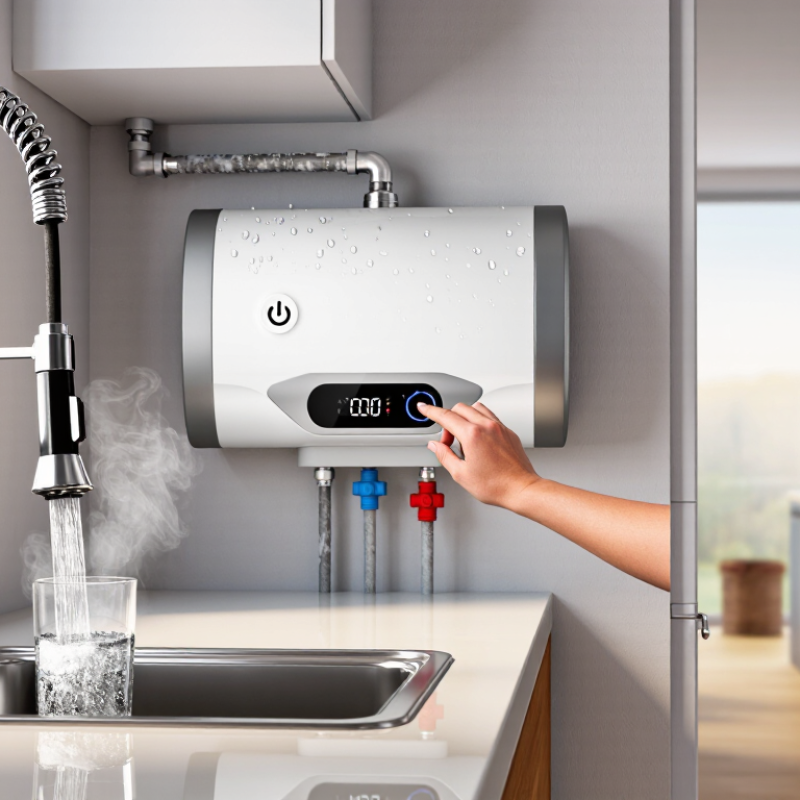
An instant electric water heater warms water as it passes through the unit, rather than storing hot water in a tank. When a tap opens, a flow sensor signals the heating elements to switch on. Water moves through a narrow chamber, absorbs heat, and flows to the fixture. No storage tank. The system stops heating when the tap closes, which can reduce standby heat loss. Actual performance depends on the incoming water temperature, flow rate, and unit capacity. A chilly winter supply may need more heating power than a mild one.
Tips: Check the manufacturer’s flow-rate and temperature-rise specifications before choosing a unit. Have a qualified electrician confirm that your home’s circuit and wiring can support its power demand. Proper sizing matters.
The appeal is clear: hot water without waiting for a tank to refill. But “instant” does not always mean unlimited hot water at every tap. A small unit may struggle when a shower and sink run together, or when water enters very cold. I would compare expected household use with the heater’s rated output, not just its compact size. Installation can also require substantial electrical capacity, so the simplest-looking model may not be the simplest fit. That part is easy to overlook.
An instant electric water heater—also called an electric tankless water heater—heats water as it flows through the unit, rather than storing a tankful of hot water. The options below compare common heater configurations by use case; they are not a brand ranking.
| Heater Configuration | Typical Power and Supply | Illustrative Flow at a 50°F Temperature Rise | How It Works | Best Suited For | Key Installation Check |
|---|---|---|---|---|---|
| Compact point-of-use unit | About 3–7 kW; commonly 120 V or 240 V, depending on the model | About 0.4–1.0 gallons per minute | A small flow sensor activates an electric resistance element when water passes through the heater. The unit supplies one nearby fixture or a limited hot-water draw. | A handwashing sink, remote bathroom sink, or location where a long pipe run causes noticeable waiting. | Confirm the unit’s voltage, circuit rating, flow capacity, and intended fixture use. A standard outlet may not be suitable for every model. |
| Single-fixture 240 V unit | About 6–12 kW; typically 240 V | About 0.8–1.6 gallons per minute | Water travels through a heat exchanger while one or more resistance elements add heat. Electronic controls may adjust power as flow changes. | A kitchen or bathroom fixture with moderate demand, where the incoming water temperature and desired flow are compatible with the unit. | Check the manufacturer’s flow-versus-temperature-rise chart and have the required dedicated circuit installed to local electrical code. |
| Whole-home electric tankless unit | Often about 18–36 kW; generally 240 V with multiple high-current circuits | About 2.5–4.9 gallons per minute, depending on power and temperature rise | A high-output heating assembly raises the temperature of water on demand. Some models stage or modulate heating elements to match flow and the set temperature. | Homes with electrical service and incoming water temperatures that support the expected number of simultaneous hot-water uses. | Check the home’s service capacity, breaker and conductor requirements, maximum simultaneous flow, and local installation rules before purchase. |
| Under-sink mini-tankless unit | Often about 3–7 kW; voltage and wiring requirements vary | Typically intended for a single low-flow fixture; actual output depends on the unit and temperature rise. | A compact heater mounted near the tap reduces the length of pipe between the heater and the point of use, while heating water only as it flows. | A remote sink or small point of use where reducing the wait for hot water is more important than supplying several fixtures. | Verify the available installation space, connection size, electrical supply, and the unit’s permitted flow range. |
How the heating process works: When a tap opens, water flow activates a sensor. The control system energizes the heating elements, and water passes through the heated chamber before leaving the unit. When flow stops, heating stops. Electric tankless heaters do not store a large volume of hot water, but their output is limited by available electrical power and incoming water temperature.
Reading the flow figures: The illustrative rates use the approximate relationship of 6.8 × heater kilowatts ÷ temperature rise in °F. They assume the heater can deliver its rated power and are not guaranteed product ratings. Colder inlet water, a higher desired outlet temperature, or simultaneous use reduces the available flow. Always check the specific model’s published performance chart and have electrical requirements assessed by a qualified professional.