Leave Your Message
Heat Pump technology has moved from a niche option to a major part of building decarbonization. The International Energy Agency reported that global heat pump sales grew nearly 15% in 2021, more than doubling their average growth rate over the previous decade. Its regional figures showed growth of about 35% in Europe, 15% in the United States, and 13% in China. These numbers describe a fast-changing market, not a guarantee that every product suits every building.
For global buyers, choosing a manufacturer means looking beyond headline efficiency. A unit’s performance depends on climate, system design, installation quality, and available service. A quiet outdoor unit beside a bedroom window may matter as much as a laboratory rating. Buyers should also compare product ranges, capacity options, controls, warranty terms, refrigerant choices, and local technical support. Small details can become costly later.
This guide introduces ten manufacturers with international relevance and considers what buyers can verify before shortlisting them. The IEA’s analysis also links wider heat pump adoption with lower emissions, while stressing the importance of efficient equipment and cleaner electricity. Still, a global ranking has limits: availability and after-sales support can vary sharply between countries. That deserves attention. Brand reputation alone is not enough, and published specifications rarely tell the whole story. The comparison is a starting point, not a substitute for project-specific advice.
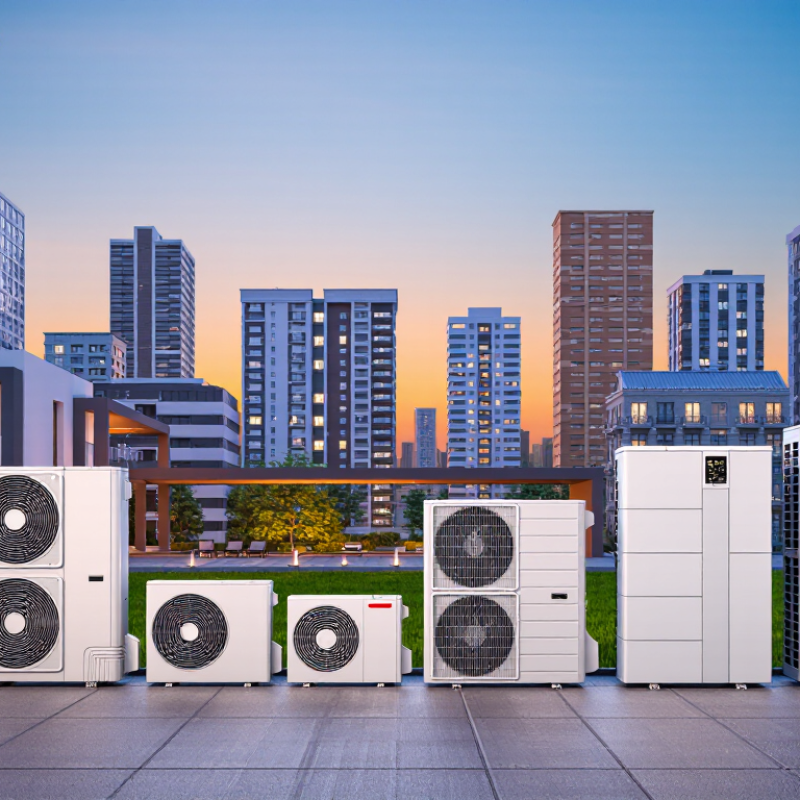
Heat pumps transfer heat rather than generate it by burning fuel. Air-source units draw energy from outdoor air; ground-source systems use buried loops, while water-source models rely on a suitable water supply. The International Energy Agency’s The Future of Heat Pumps (2022) reported that global heat-pump sales grew about 11% in 2022. Growth is strong, but choosing a system still depends on the building and climate.
Most systems use a vapor-compression cycle. The evaporator absorbs heat into refrigerant, the compressor raises its pressure and temperature, and the condenser releases heat indoors. An expansion valve then lowers pressure, restarting the cycle. In heating mode, the refrigerant carries outdoor heat to a home’s air or water circuit. Reversible units can cool, too. A high flow temperature or poorly sized radiator can reduce efficiency. The brochure COP may look neat; real winter conditions are less tidy.
Tips: Check the design heat loss, local winter temperatures, and required water temperature before comparing models. Ask for seasonal performance estimates, not just a single test-point COP. Small details matter. A control setting left unchecked can waste energy.
The table below compares ten established heat pump technology categories, rather than ranking or naming manufacturers. Product availability and performance vary by model and installation.
| No. | Heat Pump Type | Typical Applications | Operating Principle | Common Components | Buyer Considerations |
|---|---|---|---|---|---|
| 1 | Air-to-water | Space heating, cooling in reversible systems, and domestic hot water | A refrigerant circuit absorbs heat from outdoor air and transfers it to water for a hydronic heating system. | Compressor, outdoor heat exchanger, expansion device, refrigerant circuit, water-side heat exchanger, controls | Check design-temperature capacity, local winter conditions, flow-temperature requirements, and compatibility with emitters. |
| 2 | Air-to-air | Room or building heating and cooling | The refrigerant circuit moves heat between outdoor air and indoor air; a reversing valve can switch between heating and cooling modes. | Compressor, indoor and outdoor coils, fans, expansion device, reversing valve, controls | Consider zoning, indoor-unit placement, noise, filtration needs, and heating performance at low outdoor temperatures. |
| 3 | Ground-source, closed-loop | Residential, commercial, and institutional heating and cooling | A buried closed-loop pipe exchanges heat with the ground; a heat pump transfers that energy to or from the building. | Ground loop, circulating pump, heat-pump unit, heat exchangers, controls | Assess drilling or trenching conditions, land access, loop design, upfront installation cost, and long-term service access. |
| 4 | Groundwater, open-loop | Sites with a suitable, permitted groundwater source | Groundwater passes through a heat exchanger, where heat is extracted or rejected; the water is then discharged or reinjected as permitted. | Well or intake, water pump, heat exchanger, filtration equipment, discharge or reinjection system | Verify water availability and quality, permitting, discharge rules, fouling risk, and pumping energy. |
| 5 | Water-source | Buildings served by a suitable lake, river, seawater, or water loop | The unit exchanges heat with a water source or loop, then transfers it to the building through a refrigerant cycle. | Water-side heat exchanger, compressor, refrigerant circuit, pumps, strainers, controls | Check source-water temperature and flow, corrosion and biofouling protection, intake requirements, and environmental approvals. |
| 6 | Exhaust-air | Well-insulated buildings with mechanical ventilation | Heat is recovered from outgoing ventilation air and upgraded by a heat pump for space heating or water heating. | Ventilation fans, exhaust-air heat exchanger, compressor, refrigerant circuit, filters, controls | Match system capacity to ventilation airflow and building heat demand; review duct layout, filters, and supplemental heat needs. |
| 7 | Domestic hot water heat pump | Hot-water production for homes and suitable commercial facilities | A refrigerant cycle draws heat from surrounding air or another source and transfers it to stored water. | Compressor, evaporator, condenser or tank heat exchanger, insulated storage tank, controls | Review tank volume, recovery time, installation space, air-temperature limits, condensate drainage, and backup heating provisions. |
| 8 | High-temperature heat pump | Industrial process heating, hot water, and heat recovery | A purpose-designed heat-pump cycle upgrades waste heat or another source to a higher useful temperature; achievable temperatures depend on system design. | Industrial compressor, heat exchangers, refrigerant circuit, process-side pumps, instrumentation, controls | Compare source and delivery temperatures, operating hours, process integration, materials compatibility, and independently verified performance data. |
| 9 | Absorption heat pump | Applications with available heat or fuel input, including some commercial and industrial systems | A heat-driven refrigerant and absorbent cycle replaces the mechanical compressor used in conventional vapor-compression systems. | Generator, absorber, condenser, evaporator, solution pump, heat exchangers, controls | Evaluate the heat source, thermal efficiency, water or fuel requirements, maintenance capability, and suitability for the duty cycle. |
| 10 | Hybrid heat pump | Buildings combining a heat pump with a boiler or another heating source | Controls coordinate the heat pump and secondary heater, selecting or combining sources according to system settings and conditions. | Heat pump, secondary heater, system controls, sensors, valves, hydronic connections | Check control compatibility, fuel and electricity costs, emissions requirements, changeover settings, and installer expertise. |