China’s vegetable-processing sector has expanded rapidly, creating strong demand for reliable Vegetable Dryer Spinner equipment. This article introduces China’s top 10 manufacturers for buyers comparing performance, construction, and service quality.
The selection considers practical details. These include stainless-steel food-contact surfaces, basket capacity, spinning speed, drainage efficiency, motor protection, and cleaning access. A machine may look impressive in photographs. Real performance appears during repeated production cycles. Wet cabbage, spinach, carrots, and sliced potatoes expose weaknesses quickly.
Dr. R. Paul Singh, a respected food-process engineering authority, offers a useful principle: “Food quality depends on controlled processing.” This idea matters when evaluating a Vegetable Dryer Spinner. Excessive speed can bruise delicate leaves. Low speed can leave water trapped between layers. Poor balance may create vibration, noise, and premature bearing wear.
The listed manufacturers should therefore be viewed as starting points, not automatic winners. Buyers should request test videos, material certificates, operating data, and customer references. They should also confirm whether quoted capacity reflects real vegetables or empty-basket calculations. That difference can be surprisingly large.
Small details matter.
A dependable supplier should explain installation, spare parts, warranty coverage, and operator training clearly. Regional service availability can influence total cost more than the initial quotation. Some manufacturers offer polished brochures but limited technical follow-through. That is an uncomfortable issue, yet it deserves attention.
This overview aims to support careful comparison. Factory visits, sample testing, and written specifications remain essential before purchase.
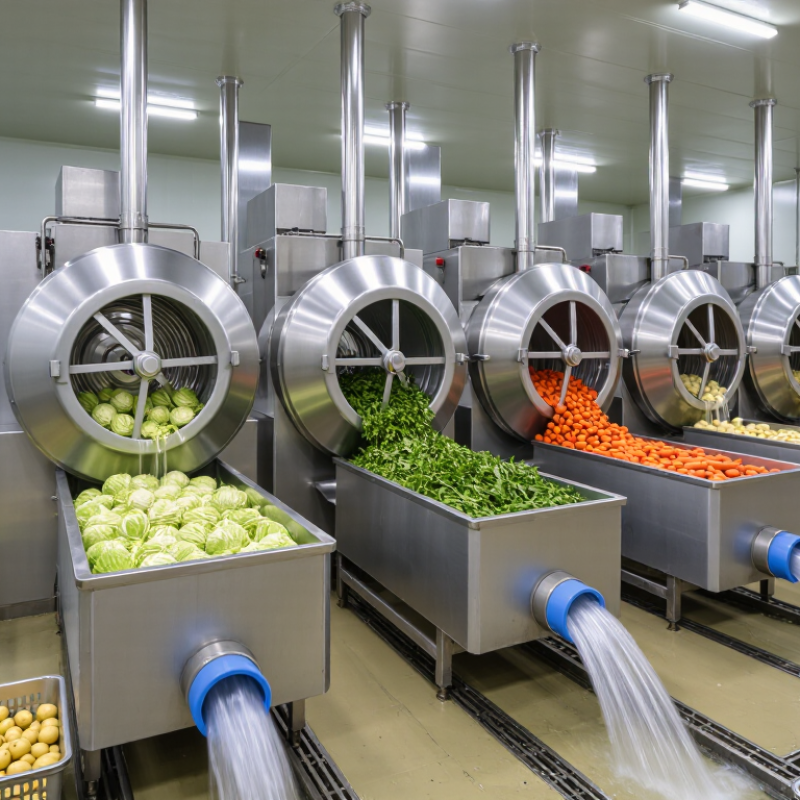
A vegetable dryer spinner is a food-processing machine that removes surface water from washed vegetables. It uses centrifugal force rather than heat. Inside the drum, a perforated basket rotates rapidly while water moves outward through small openings. The collected water then flows into a drain or removable tank.
In practical use, operators load lettuce, spinach, cabbage, herbs, or sliced vegetables into the basket. The lid must close firmly before the motor starts. A short spinning cycle often removes loose water without cooking or wilting the produce.
Speed controls matter. Soft leaves may need gentle rotation, while dense vegetables can tolerate a faster cycle. The basket should stay balanced. Otherwise, vibration becomes loud and may damage the drive system.
Cleanability is a key engineering concern. Food-contact surfaces should resist corrosion and allow quick inspection around seals, holes, and drain points. Stainless steel construction is common for this reason. Operators should avoid filling the basket completely, even when production pressure is high. An overloaded spinner may leave wet centers and bruise fragile leaves. It also strains the motor. Not perfectly dry.
A dryer spinner does not replace a hot-air drying chamber.
It removes free water from the surface, helping vegetables pack better and reducing excess moisture during storage. Actual performance depends on crop variety, load size, spin time, and washing conditions. In field testing, measuring moisture before and after each cycle gives more reliable settings than relying on sound or appearance alone.
The selection begins with production evidence, not online visibility. FAO’s State of Food and Agriculture 2023 reports that 13.2% of food is lost between harvest and retail. Effective drying equipment can reduce moisture-related waste after washing and cutting. We examine whether each manufacturer provides repeatable drying results for leafy vegetables, sliced roots, and herbs.
13.2%
of food is lost between harvest and retail.
Factory verification matters. Auditors review machining areas, assembly lines, welding quality, and spare-parts storage. They also inspect stainless-steel contact surfaces, drainage angles, and basket balance. A stable spinner should limit vibration during high-speed operation. Small details matter. Loose bearings do not.
Testing records receive significant weight. Suppliers should provide moisture readings, batch capacity, cycle time, noise levels, and energy consumption. These figures must come from identifiable test conditions. ISO 9001 certification supports process control, but it cannot prove machine performance alone. Food-contact material documents and electrical safety records are also checked. We compare after-sales response times and installation guidance across different provinces.
1.05 billion tonnes
of food waste in 2022.
UNEP’s Food Waste Index Report 2024 estimated 1.05 billion tonnes of food waste in 2022. That figure strengthens the case for reliable post-wash handling equipment. However, laboratory results may not match a busy vegetable factory. This is where selection becomes imperfect. Real operators should request trials using their own produce, water volume, and loading habits before purchase.
China’s top ten vegetable dryer spinner manufacturers differ in workshop scale, engineering focus, and service capability. One specializes in compact stainless-steel machines for restaurants and small processors. Another builds high-capacity centrifugal spinners for leafy vegetables. A third focuses on belt dryers with adjustable air temperature and speed. One manufacturer combines washing, spinning, and drying lines, reducing manual transfer between stages. Another serves private-label equipment buyers and adapts drum sizes to daily output. A sixth emphasizes low-noise motors for indoor food plants. One supplier develops energy-saving airflow systems, while another offers simple machines for farms with limited technical staff. A ninth concentrates on hygienic frames and tool-free cleaning. The tenth provides integrated controls, weighing devices, and remote troubleshooting.
Reliable profiles should include more than production photos. Buyers should inspect food-contact materials, weld quality, drainage design, motor protection, and test records. In practical factory visits, small details matter: water collecting under a frame can create cleaning problems, while an uneven basket may damage tender spinach. Manufacturers with experienced technicians usually explain moisture targets clearly. They also provide operating manuals, spare-part lists, and training instead of making vague promises. Performance should be checked with the buyer’s actual vegetables, not only empty-machine demonstrations. No factory is perfect. Some workshops communicate well but document poorly; others offer strong engineering but slow after-sales responses. A careful comparison should review throughput, final moisture, power consumption, noise, delivery terms, and service history before selecting a supplier.
| Rank | Anonymous Profile | Primary Equipment Focus | Vegetable Processing Applications | Typical Capacity Range | Common Drying Temperature Range | Core Construction Materials | Automation Features | Typical Energy Options | Quality and Compliance Indicators | Market Positioning |
|---|---|---|---|---|---|---|---|---|---|---|
| 1 | Profile A | Continuous mesh-belt vegetable dryers with integrated centrifugal dewatering | Leafy vegetables, sliced roots, onion, garlic, cabbage and herbs | 300–2,000 kg/h fresh feed | 50–90°C, depending on product and target moisture | Food-contact stainless steel, commonly SS304; SS316 available for corrosive or saline environments | PLC control, multi-zone temperature control, variable-speed conveyor and alarm monitoring | Steam, hot water, natural gas, biomass or electric heating | HACCP-oriented design; food-grade welding and cleanable surfaces | Large-scale vegetable-processing lines |
| 2 | Profile B | Batch tray dryers and hot-air circulation cabinets | Mushrooms, chili, fruit-vegetable slices, medicinal plants and small-batch produce | 50–500 kg per batch | 45–85°C | Stainless-steel trays, insulated panels and corrosion-resistant internal chambers | Digital temperature controller, timer, air-speed adjustment and recipe storage | Electric, steam or hot-water heating | Suitable for hygienic food production when operated with documented cleaning procedures | Small and medium processors requiring flexible production |
| 3 | Profile C | Microwave-assisted or hybrid hot-air drying systems | High-value vegetables, instant-food ingredients and products requiring shorter drying cycles | 100–800 kg/h fresh feed | 40–80°C air temperature, with microwave power controlled separately | Stainless-steel drying chamber, food-grade conveyor and shielded microwave enclosure | Power modulation, moisture monitoring, conveyor-speed control and interlock protection | Electricity | Requires validated process controls and electrical safety inspection | Quality-focused and time-sensitive applications |
| 4 | Profile D | Heat-pump dehumidification dryers | Green vegetables, mushrooms, herbs and color-sensitive sliced produce | 100–1,000 kg per batch | 35–70°C | Insulated stainless-steel chamber, food-grade racks and low-temperature air ducts | Humidity control, automatic defrosting, programmable cycles and remote monitoring options | Electric heat-pump system | Low-temperature processing supports color and aroma retention; product validation remains necessary | Energy-conscious and premium-quality production |
| 5 | Profile E | Fluidized-bed dryers for diced and granular vegetables | Diced carrots, peas, corn, potato pieces, beans and vegetable granules | 100–1,500 kg/h | 55–95°C | Stainless-steel air plenum, perforated product deck and sanitary discharge components | Air-flow regulation, feed-rate control, temperature sensors and automatic discharge | Steam, gas, biomass or electric heating | Best suited to uniform particle sizes and controlled feed preparation | Efficient drying of free-flowing cut vegetables |
| 6 | Profile F | Vacuum drying equipment for low-oxygen processing | Dehydrated vegetables, sensitive herbs, nutraceutical ingredients and specialty products | 20–300 kg per batch | 30–70°C under reduced pressure | Vacuum-rated stainless-steel chamber, food-grade shelves and sealed door system | Vacuum regulation, shelf-temperature control, pressure alarms and programmable recipes | Electric, thermal oil or hot-water heating | Suitable for products where oxidation and heat exposure must be limited | Specialty and high-value vegetable ingredients |
| 7 | Profile G | Solar-assisted and biomass-supported drying systems | Seasonal vegetables, chilies, sliced roots, leaves and agricultural cooperatives’ produce | 100–1,000 kg per batch | 40–75°C | Insulated drying chamber, stainless-steel product trays and protected hot-air exchanger | Temperature display, ventilation control and optional humidity monitoring | Solar thermal energy, biomass, gas or electric backup | Energy performance depends on climate, insulation and auxiliary heat availability | Rural, regional and operating-cost-sensitive applications |
| 8 | Profile H | Rotary drum and tunnel drying systems | Large-volume sliced vegetables, root crops, vegetable by-products and pre-dried materials | 500–3,000 kg/h fresh feed | 60–120°C, based on product tolerance and residence time | Carbon-steel insulated exterior with stainless-steel food-contact sections | Drum-speed control, burner management, temperature monitoring and automatic feeding | Natural gas, LPG, biomass, steam or hot air | High throughput; hygienic design should be reviewed for the specific food-contact zones | Heavy-duty industrial production |
| 9 | Profile I | Integrated washing, centrifugal dewatering and drying lines | Fresh-cut vegetables, salad ingredients, leafy greens and ready-to-process vegetables | 300–1,500 kg/h fresh feed | 45–80°C after mechanical dewatering | Food-grade stainless steel throughout wet and dry processing zones | Conveyor synchronization, dewatering-speed control, PLC recipes and online temperature monitoring | Electric, steam, gas or hot-water heating | Designed to reduce surface water before thermal drying and improve line consistency | Integrated processing lines for fresh-cut operations |
| 10 | Profile J | Modular multi-pass belt dryers for customized line expansion | Vegetable flakes, slices, powders, herbs and mixed dehydrated ingredients | 200–1,800 kg/h fresh feed | 50–100°C with staged air circulation | Stainless-steel belts, insulated panels, sanitary air ducts and removable inspection sections | Multi-zone control, belt-speed adjustment, exhaust-air control and data logging | Steam, gas, biomass, hot water or electric heating | Modular layout supports capacity expansion and product-specific process validation | Versatile plants serving multiple vegetable categories |
Note: Capacity and temperature ranges are representative industry ranges. Actual performance depends on vegetable variety, slice thickness, initial moisture, target moisture, airflow, loading density and process configuration.
When comparing China’s top ten vegetable dryer spinner manufacturers, technology reveals the clearest differences. Some use centrifugal baskets, while others combine air knives, vibration, or variable-speed rotation. Centrifugal systems remove surface water quickly, but excessive speed can bruise lettuce leaves. Variable-frequency drives help operators adjust rotation for spinach, cabbage, and sliced carrots. Touchscreen controls improve operation, although simple switches may be more reliable in wet processing rooms. That trade-off matters.
Capacity changes the machine’s daily role. Small units may process 20–50 kilograms per hour, fitting restaurants and pilot lines. Medium equipment often handles 100–300 kilograms, depending on moisture, loading, and cycle time. Large continuous systems can exceed 500 kilograms per hour, but they need stronger drainage and stable feeding. Rated output is not actual output. Request test data using the buyer’s vegetables, not dry laboratory samples. Product shape also affects sanitation and maintenance. Removable baskets, rounded welds, and tool-free covers can reduce cleaning time. Yet overly complex frames may trap water.
During factory evaluations, inspect noise, vibration, basket balance, and emergency-stop access. Ask how operators replace seals and bearings. A polished brochure cannot show those details. Electrical standards, food-contact materials, documentation, and after-sales training separate reliable suppliers from merely capable manufacturers. A lower-capacity spinner may perform better when gentler handling and easier cleaning matter more than speed.
This industry benchmark compares typical equipment classes used by Chinese vegetable dryer spinner manufacturers. Capacity and spin-speed ranges are based on commonly published commercial equipment specifications; actual performance varies by model, vegetable type, moisture content, and operating conditions.
Key takeaway: Compact and commercial batch machines prioritize flexible production and easy cleaning, while industrial batch and continuous systems provide higher throughput. Variable-speed drives, stainless-steel food-contact surfaces, balanced baskets, programmable controls, and automatic discharge are the main design differences across equipment classes.
China Top 10 Vegetable Dryer Spinner Manufacturers
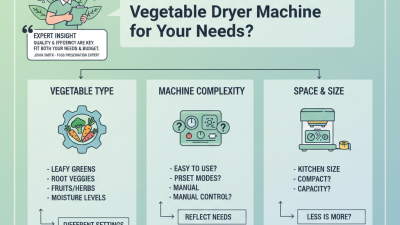
Choosing among China’s top vegetable dryer spinner manufacturers requires more than comparing prices. Start with your product, daily output, moisture target, and available floor space. Leafy greens, sliced carrots, and herbs need different spinning speeds and basket designs. Ask each manufacturer for test results using your own vegetables. Sample trials reveal problems that brochures often hide.
Inspect the machine’s food-contact parts carefully. Stainless steel should be suitable for food processing and easy to clean. Check welds, drainage points, safety guards, and emergency stops. A stable basket matters. Excessive vibration can damage delicate leaves and increase maintenance costs. Confirm the motor’s power, speed control, noise level, and electrical requirements before ordering. Small details matter.
Request drawings, spare-parts lists, operating videos, and a clear warranty statement. Reliable manufacturers explain cleaning routines and provide practical training. They should also answer how quickly replacement seals and bearings can be supplied. Factory visits, video inspections, and customer references can strengthen your judgment. Do not trust polished claims alone. A cheaper machine may consume more labor because water removal is uneven. An expensive model may still be poorly matched to your batch size. This is where buyers often misjudge the purchase. Compare verified performance, service response, and long-term operating cost, not only the quoted figure.