China has become a major sourcing hub for air-source heat pump technology. Global buyers now examine more than factory prices. They need stable performance, responsive service, and clear compliance documentation. This guide introduces leading China Top Split Heat Pump Manufacturers for commercial and residential projects. It focuses on practical selection factors, not promotional rankings alone.
A reliable Heatpump Split supplier should explain its testing process in plain language. Buyers should review heating capacity, seasonal efficiency, operating noise, defrost performance, and refrigerant options. Factory audits can reveal useful details, including compressor storage, insulation quality, wiring control, and final inspection procedures. Product samples matter. A specification sheet cannot show every vibration or installation difficulty.
Market experience also shows a less comfortable truth. A low quotation may hide weak technical support or costly replacement parts. Some manufacturers communicate well before payment, then respond slowly after delivery. This risk deserves attention. Ask for production photographs, test reports, warranty terms, spare-part lists, and references from similar climates. Regional requirements may differ, so certifications must match the target market rather than appear impressive on paper.
The strongest suppliers usually combine engineering depth with practical communication. They can adjust controls, casing protection, and connection options for different projects. They also admit product limitations. That honesty is valuable. Buyers should compare factories through evidence, documented procedures, and realistic operating data. This approach supports safer purchasing decisions and more dependable long-term Heatpump Split installations.
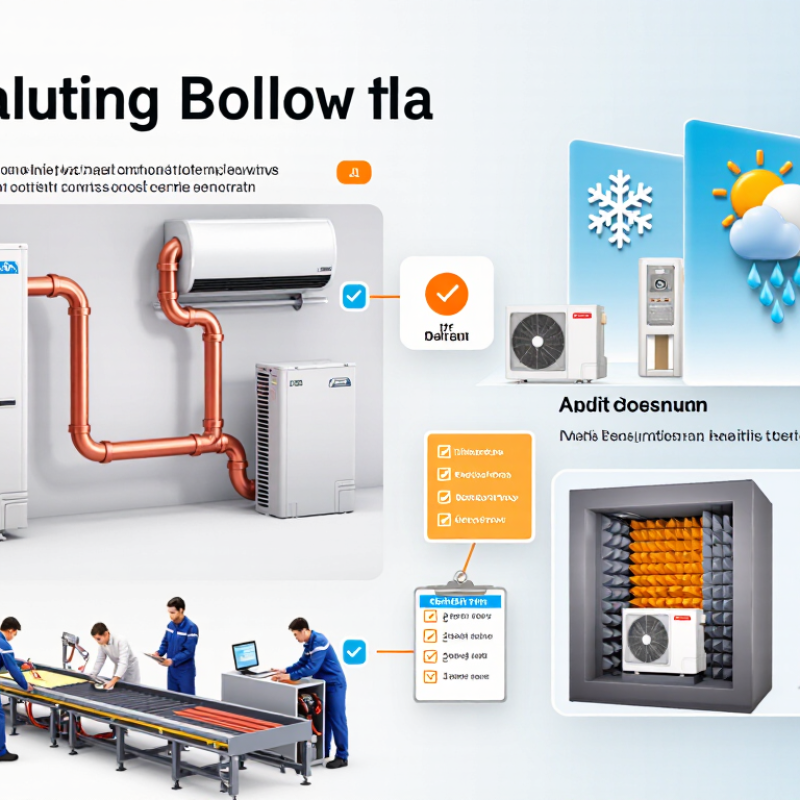
A split heat pump uses two connected units to move heat instead of creating it directly. The outdoor unit absorbs or rejects heat through a coil, fan, and compressor. The indoor unit distributes conditioned air through a room. Refrigerant pipes and control cables connect both sections. In heating mode, a reversing valve changes the refrigerant flow. This allows one system to provide heating and cooling throughout the year.
China leads much of this production because its supply chain is unusually concentrated. Compressor makers, copper tube suppliers, electronic producers, and plastic processors operate within efficient manufacturing regions. Shorter transport distances can reduce production delays and simplify quality coordination. Large factories also invest in automated brazing, leak testing, noise measurement, and low-temperature performance tests.
These details matter when equipment must operate beside a bedroom or during a freezing winter night. Export manufacturers commonly design products for different voltage systems, climates, and certification requirements.
The advantage is not only low cost. It is manufacturing depth. Engineers can adjust software, heat exchangers, and fan motors after field feedback. Still, the picture is imperfect. Some suppliers emphasize appearance while neglecting service access or documentation. Buyers should examine test reports, warranty procedures, spare-part availability, and installation guidance. A reliable split heat pump depends on more than the outdoor cabinet. Poor sizing, incorrect refrigerant charging, or weak airflow can reduce efficiency sharply. Factory capability helps, but careful engineering and local installation remain essential.

China’s split heat pump makers increasingly combine inverter compressors with brushless DC motors. This allows the outdoor unit to adjust output instead of cycling at full power. In practical testing, stable modulation can reduce temperature swings and compressor stress. Engineers also use microchannel or enhanced-copper heat exchangers to improve heat transfer in compact cabinets. Fin spacing matters. Narrow fins may perform well, but they collect dust faster in dry environments.
A modern production line usually includes automated tube expansion, controlled brazing, vacuum drying, and electronic leak detection. These steps help prevent refrigerant loss and moisture-related failures. Many factories inspect every connection with pressure testing before charging the system. They also calibrate temperature, pressure, and current sensors during end-of-line testing. Poor calibration can make an efficient unit behave like an ordinary one.
Control software has become equally important. Adaptive defrost logic can reduce unnecessary heating interruptions during cold, humid weather. Wi-Fi monitoring and fault records support easier maintenance for distributors and installers. However, software is not a cure for weak hardware. I have seen promising prototypes fail because drainage froze or outdoor fans were poorly balanced. Manufacturing quality still depends on operator training, fixture accuracy, and repeatable testing. Some production details remain imperfect, especially when one platform serves many climates. Global buyers should review test data, component traceability, and field feedback before approving large orders.
Choosing China’s top split heat pump manufacturers requires more than comparing quoted prices. Check how each factory controls production, testing, and after-sales service. Request factory audit records, product test reports, and evidence of quality management systems. Confirm the unit’s heating capacity at low outdoor temperatures, not only under standard laboratory conditions. Ask for COP, seasonal efficiency, noise levels, defrost performance, and operating limits. These details matter in real homes.
Review the manufacturer’s engineering experience with your target climate. A supplier serving cold regions should explain compressor protection, insulation, and condensate control clearly. Request a sample before placing a large order. Inspect the outdoor coil, wiring, controller, packaging, and installation instructions. Speak with recent buyers if possible. A polished website proves little. Warranty terms, spare-parts availability, response times, and remote troubleshooting often reveal stronger reliability. Payment terms deserve attention too. Cheap equipment can become expensive after one winter.
Tips: Compare identical specifications, not attractive headlines. Ask who handles warranty claims in your market. Verify refrigerant, electrical, and safety compliance for the destination country. Keep written records of every technical promise. I would also test communication speed before signing. Slow replies during evaluation may become slower after delivery. No supplier is perfect; even strong factories can miss a detail, so independent inspection remains worthwhile.
China’s leading split heat pump manufacturers serve different climate and building needs. Common products include air-to-air systems, air-to-water units, and high-temperature models for radiators. Low-ambient versions can operate in cold regions, but buyers should verify capacity at actual winter temperatures. Product sheets often highlight COP values. Ask for test conditions, sound levels, defrost performance, and standby consumption.
Certifications support safer international sourcing. Depending on the destination, buyers may require CE, UKCA, ETL, CB, RoHS, ErP, or local energy labels. ISO 9001 can indicate controlled production, but it does not replace product testing. Request current certificates, laboratory reports, refrigerant details, and factory quality records. A remote audit helps, although it cannot reveal every production weakness. That limitation deserves attention.
Tips: Match voltage, frequency, pipe length, and control language before ordering samples. Discuss customization early. Options may include casing colors, Wi-Fi controls, smart-grid interfaces, heat-exchanger materials, and private-label packaging. Some factories can adjust software logic or create special mounting brackets. These changes may increase tooling costs and lead times. In my experience, buyers sometimes focus on purchase price and overlook service parts. Confirm warranty terms, spare-part availability, installation manuals, and technician training. A detailed sample test is wise. Even reliable specifications can perform poorly when local installation practices differ.
| Product Type | Typical Application | Common Capacity Range | Typical Operating Range | Refrigerant Options | Performance and Design Features | Common Export Certifications and Standards | Customization Options | Key Buyer Considerations |
|---|---|---|---|---|---|---|---|---|
| Residential Split Air-to-Water Heat Pump | Space heating, cooling, and domestic hot water for villas and small residential buildings | 4–16 kW thermal output, depending on climate and design conditions | Heating operation commonly specified from approximately −25°C to 35°C outdoor temperature; exact limits vary by model | R32R290 | Variable-speed compressor, weather-compensation control, low-noise fan, plate heat exchanger, optional backup heater | CERoHSREACHEN 14511EN 14825IEC 60335-2-40 | Voltage and frequency, controller language, hydraulic connections, casing color, Wi-Fi gateway, backup-heater rating, logo-free packaging | Check low-ambient capacity, leaving-water temperature, seasonal efficiency, sound power level, and local electrical requirements |
| Split Domestic Hot Water Heat Pump | Hot-water production for homes, apartments, hotels, and small commercial facilities | 2–8 kW heating capacity with separate indoor water tank options commonly ranging from 100–300 L | Air-source operation is commonly designed for approximately −15°C to 43°C; confirm the supplier’s tested range | R32R290 | Corrosion-resistant water tank, anti-legionella cycle, immersion-heater backup, temperature scheduling, condensate management | CEErPRoHSEN 16147IEC 60335-2-40 | Tank volume, coil configuration, anode type, water-pipe size, display language, sanitation program, installation orientation | Verify hot-water recovery time, tank insulation thickness, standing heat loss, pressure rating, and potable-water compliance |
| High-Temperature Split Heat Pump | Radiator retrofit, building renovation, process preheating, and applications requiring elevated water temperatures | 8–30 kW thermal output in common modular residential and light-commercial configurations | Outdoor operating limits depend on refrigerant and compressor design; leaving-water temperatures may reach approximately 60–75°C in specified conditions | R32R290R134a alternatives | Enhanced vapor injection or two-stage compression on selected designs, cascade control, anti-freeze protection, high-temperature disinfection | CEEN 14511EN 14825EN 378IEC 60335-2-40 | High-temperature setpoint, cascade operation, hydraulic module, buffer-tank integration, BMS protocol, defrost strategy | Request performance data at the actual supply-water temperature; efficiency can decline significantly at higher temperature lifts |
| Commercial Modular Split Heat Pump | Schools, offices, retail buildings, restaurants, apartment blocks, and mixed-use properties | 20–100 kW system capacity through multiple connected modules | Typical heating design range is approximately −20°C to 35°C, subject to project configuration and certification data | R32R410AR290 | Lead-lag sequencing, duty rotation, staged defrost, remote monitoring, hydraulic separation, fault-code diagnostics | CEERPEN 14511EN 14825EN 378ISO 9001 production systems | Module quantity, control logic, pump package, plate heat exchanger, BMS integration, enclosure dimensions, project-specific wiring | Evaluate part-load efficiency, redundancy, service access, maximum refrigerant charge, lifting requirements, and commissioning support |
| Cold-Climate Split Heat Pump | Residential and light-commercial heating in northern Europe, North America, and other cold regions | 6–25 kW nominal heating capacity, with capacity derating at low ambient temperatures | Selected models are designed for operation down to approximately −25°C or lower; verified capacity data is essential | R32R290 | Enhanced vapor injection, crankcase heater, intelligent defrost, oversized outdoor heat exchanger, freeze protection, low-temperature control | CEUKCA where applicableEN 14511EN 14825IEC 60335-2-40 | Cold-start parameters, auxiliary-heater control, insulated hydraulic kit, low-temperature alarms, regional controller software | Compare COP and delivered capacity at −7°C, −15°C, and −20°C rather than relying only on nominal capacity |
| All-in-One Split Heat Pump System | New-build homes and packaged heating, cooling, and hot-water installations | 4–16 kW heat-pump output with integrated indoor hydraulic module and optional 150–300 L tank | Commonly configured for approximately −20°C to 43°C outdoor temperature, depending on model | R32R290 | Integrated circulation pump, expansion vessel, safety valve, electric heater, touchscreen controller, compact installation layout | CEErPRoHSREACHEN 14511 | Tank size, hydraulic kit, grid connection, interface language, smart-grid input, photovoltaic surplus control, cabinet dimensions | Confirm transport dimensions, installation clearance, service-panel access, component availability, and local installer skill requirements |
| Swimming Pool Split Heat Pump | Residential pools, commercial pools, spas, and seasonal aquatic facilities | 5–50 kW heating capacity, with sizing dependent on pool volume, cover, climate, and desired temperature | Many models operate in heating mode from approximately 5°C to 43°C ambient temperature | R32R410AR290 | Titanium heat exchanger, automatic defrost, quiet fan mode, digital thermostat, flow switch, corrosion-resistant casing | CEEMC/LVD complianceRoHSEN 14511 testing | Pool-water connection size, salt-water compatibility, casing material, controller language, Wi-Fi module, branding-free carton design | Check performance at the intended air and water temperatures, salt concentration, water-flow requirement, and sound level |
| Low-GWP Natural-Refrigerant Split Heat Pump | Projects prioritizing lower refrigerant global-warming impact and future regulatory alignment | Residential and light-commercial capacities commonly available from 4–30 kW | Operating range and capacity depend strongly on the selected refrigerant, charge size, and safety design | R290Other low-GWP options | High seasonal efficiency potential, sealed refrigerant circuit, charge-limiting design, ventilation and safety controls where required | CEF-Gas compliance where applicableEN 378IEC 60335-2-40EN 14511 | Refrigerant charge, installation-zone configuration, safety sensors, controller logic, hydraulic module, regional compliance documentation | Confirm flammability classification, charge limits, installation requirements, technician qualifications, and country-specific legislation |
Importing split heat pumps from China can lower equipment costs, but the lowest quotation often hides important variables. Buyers should compare complete system specifications, not only outdoor unit prices. Check heating capacity at low ambient temperatures, seasonal efficiency, sound pressure, defrost performance, and standby power. Ask for tested data under conditions close to your project. Laboratory figures can look impressive. They may not match a cold, windy installation site.
Supplier selection needs evidence. Request factory quality procedures, production photographs, inspection records, and references from comparable climates. A pre-shipment inspection should verify model numbers, wiring, insulation, packaging, and accessories. Confirm refrigerant type and electrical configuration before ordering. Also clarify warranty response times, spare-part availability, remote diagnostics, and technical training. These details often affect lifecycle cost more than a small unit-price discount.
Costs also include tooling, inland transport, export packing, freight, duties, installation, and commissioning. Use a written quotation with agreed Incoterms and payment milestones. A pilot shipment is safer than committing to large volumes immediately. I would still leave room for uncertainty. Forecasts can miss seasonal demand, and installation teams may need extra fittings. A supplier that answers technical questions clearly is often more valuable than one offering the cheapest price. Keep performance claims, drawings, and acceptance criteria in the contract.